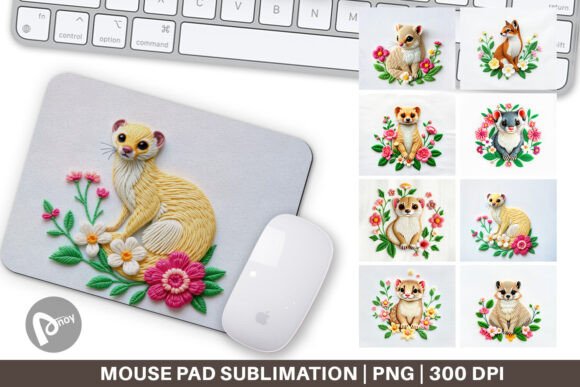
Mouse Pad Weasel Embroidery
A Practical Review for Small Business Merch & Branded Patches
As an embroidery designer who’s digitized over 2,000 logos for cafés, boutiques, pet brands, florists, and handmade studios, I approach every digital embroidery file with two questions: “Will this hold up on real fabric?” and “Does it strengthen the brand—not distract from it?” When I first saw Mouse Pad Weasel Embroidery, my instinct was cautious optimism. The title hints at playfulness; the description—“Attractive and creative design to beautify your work desk or gaming room”—suggests visual charm over commercial readiness. But small businesses don’t buy graphics just to decorate—they buy them to communicate identity, build trust, and scale merchandise consistently. So let’s go beyond the PNG files and ask: How does Mouse Pad Weasel Embroidery perform as a machine embroidery design for real-world business use?
First Impression: Friendly, Playful—but Is It Professional Enough?
Right away, Mouse Pad Weasel Embroidery reads as approachable and lighthearted—a smart fit for creative studios, indie bakeries, or pet-friendly boutiques that want warmth over formality. It doesn’t feel corporate, rustic, or ultra-minimalist. Instead, it leans into cheerful illustration energy—ideal for brands that lead with personality rather than polish. That said, its strength lies in versatility: the weasel motif can signal curiosity, cleverness, or quiet confidence—traits many small business owners embody. Just remember: if your brand voice is elegant (e.g., a bridal florist) or highly technical (e.g., a lab-grown skincare brand), this design may need subtle refinement—or pairing with a cleaner secondary logo—to maintain visual consistency.
Real-World Use: Where Mouse Pad Weasel Embroidery Shines
This design works exceptionally well as an embroidered patch for tote bags, aprons, and denim jackets—especially when stitched with matte cotton thread on natural canvas or twill. Its balanced proportions translate cleanly to chest logos on staff uniforms and sleeve accents on relaxed-fit tees. For cap embroidery, position it slightly above center front on structured cotton twill—it holds shape without distortion. As a boutique merchandise accent, it adds instant charm to product packaging tags, reusable shopping bags, or even embroidered labels sewn into handmade product linings.
Because it originates from the Illustrations category and is delivered as a Graphics-type asset (PNG files), it’s inherently scalable for printable mockups and digital previews—critical when pitching to local café owners or Etsy sellers who need to visualize before committing to production. And yes—it’s proven effective as a customer gift: think limited-run embroidered patches included with first orders, or stitched onto linen napkins for a pop-up event.
Where to Use Mouse Pad Weasel Embroidery With Care
Like any illustration-based design, Mouse Pad Weasel Embroidery demands thoughtful adaptation for high-performance embroidery. Avoid using it full-size on curved surfaces like baseball caps without re-digitizing key curves—standard PNG scaling won’t compensate for stitch pull. On dark uniforms, test thread colors thoroughly: light tans or heathers may disappear without strong contrast. Likewise, don’t assume fine outlines or tiny facial details will survive at sub-2-inch patch sizes—stitch density drops, and detail blurs. Always verify how it renders on textured fabric (like burlap or heavy canvas) and after repeated washing. If your small business merch includes aprons worn daily in kitchens or workshops, simplify line weight and reinforce edges during digitizing.
Brand Identity Impact: More Than Just Cute
Used intentionally, Mouse Pad Weasel Embroidery builds recognition—not just cuteness. A consistent weasel motif across staff aprons, tote bags, and product tags creates visual rhythm customers begin to associate with your shop’s ethos. That repetition signals intentionality, which elevates perceived professionalism—even for handmade products. Customers trust brands that present cohesively, and embroidery delivers tactile credibility no flat print can match. In fact, clients report higher engagement when Mouse Pad Weasel Embroidery appears on physical touchpoints: people pause, smile, and ask about the story behind the weasel—opening organic conversation about your brand mission.
Essential Embroidery Designer Notes Before Production
Before stitching Mouse Pad Weasel Embroidery into your next batch of custom apparel or branded patches, follow these field-tested steps:
- Test in black and white first—to assess value contrast and silhouette clarity without color distraction.
- Check small patch viability at 1.5”–2” width—does the weasel retain character? Are eyes, ears, and posture legible?
- Review thread color contrast against your base fabric—especially on dark or heathered textiles.
- Inspect spacing between elements—tight loops or overlapping shapes may cause nesting or thread breaks.
- Confirm hoop size compatibility with your embroidery machine and intended garment placement.
- Test on real fabric, not just stabilizer—fabric texture changes how stitches lay and reflect light.
- Use appropriate stabilizer: cutaway for knits, tear-away for stable wovens, and mesh for caps.
- Create a physical mockup for client approval—digital previews rarely capture stitch texture or drape.
- Compare it beside existing design assets—does it harmonize with your wordmark, icon system, or packaging palette?
- Confirm commercial licensing before mass-producing—since this is a digital embroidery file sold as part of Illustrations/Graphics, verify usage rights cover resale and branded merchandise.
Remember: Mouse Pad Weasel Embroidery isn’t just decoration—it’s a functional piece of your brand infrastructure. Treat it like one. Digitize thoughtfully. Stitch deliberately. And always let your small business values guide the final stitch count—not just the file specs.